GazeLIFT
Gaze-Guided Few-Shot Adaptation
for Medical Image Segmentation
1 L2TI, Institut Galilée, Université Sorbonne Paris Nord, France
2 Northwestern University, USA
GazeLIFT uses fixation locations and durations to condition frozen DINOv3 features for polyp and prostate segmentation.
Main configuration, seed 42. Parameter count excludes the frozen DINOv3 encoder, which is required at inference.
METHOD
Model architecture
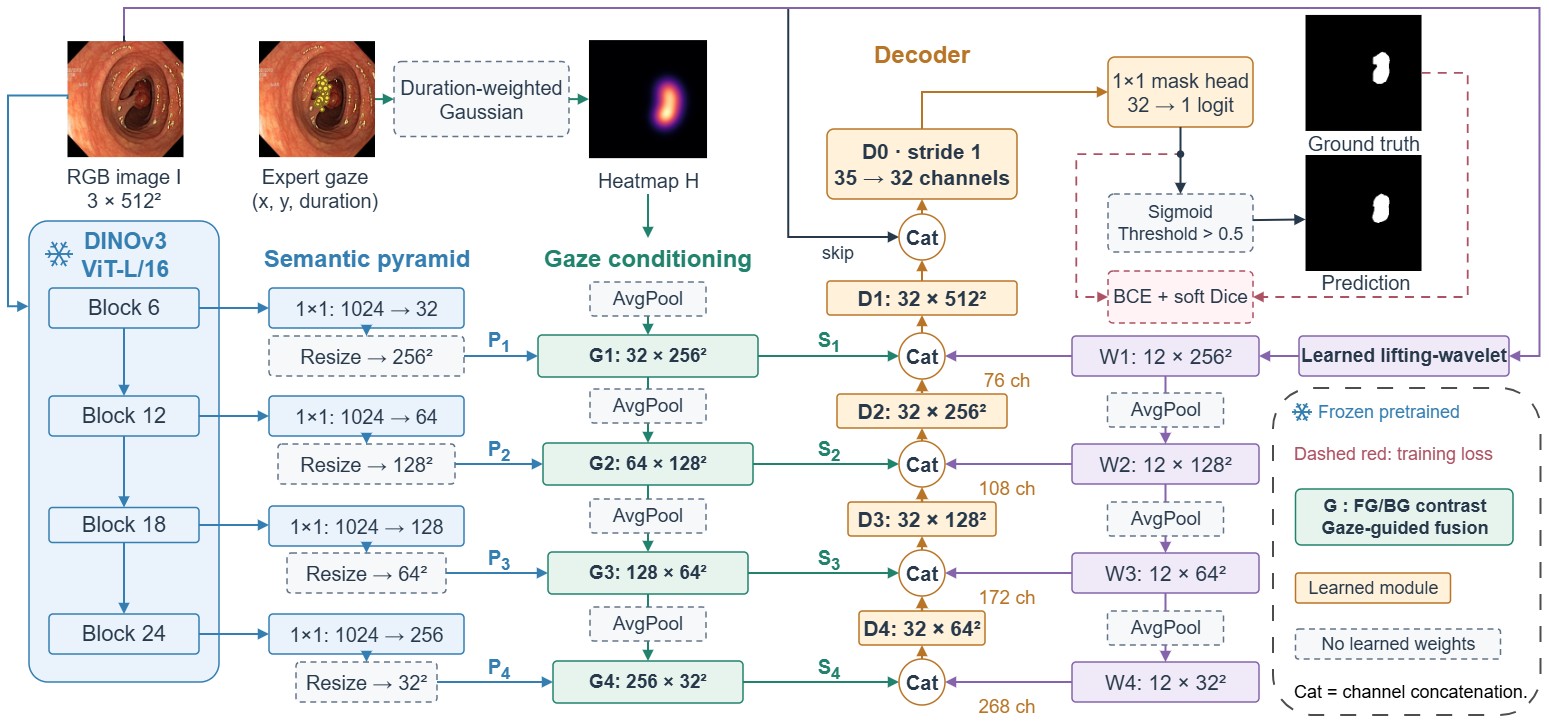
GazeLIFT conditions multi-depth DINOv3 features using duration-weighted gaze and foreground–background prototype contrast. A learnable lifting-wavelet branch supplies image features. The decoder combines these inputs to predict a mask.
GazeLIFT architecture
Feature extraction
Frozen DINOv3 features are extracted at blocks 6, 12, 18 and 24.
Gaze conditioning
Fixation locations and durations form heatmaps that guide prototype contrast and feature adaptation.
Mask prediction
Wavelet features and RGB information complement the semantic features in the segmentation decoder.
RESULTS
Accuracy and training-run variability
Across seeds 40–54, GazeLIFT improves the mean test Dice over the without-gaze configuration on both datasets. Values below report mean ± SD across training runs; confidence intervals describe the estimated run-level mean.
| Dataset | Without gaze | GazeLIFT | Paired gain (95% CI), pp |
|---|---|---|---|
| Kvasir-SEG | 90.28 ± 0.54 95% CI [90.03, 90.56] | 93.22 ± 0.44 95% CI [93.00, 93.43] | +2.94 [2.69, 3.18] |
| NCI-ISBI | 84.25 ± 0.88 95% CI [83.81, 84.67] | 87.94 ± 0.79 95% CI [87.54, 88.31] | +3.70 [3.11, 4.29] |
Test sets: 100 Kvasir-SEG images and 117 NCI-ISBI slices. These intervals quantify training-run variability on fixed test sets; they do not establish performance on new clinical populations. Paired gains use unrounded run scores.
Mean Dice (%) from the main comparison. Evaluation protocols differ across methods.
| Method | Kvasir-SEG | NCI-ISBI |
|---|---|---|
| GazeMedSAMv2 | 85.19 | 85.62 |
| GazeRefine | 88.10 | 80.28 |
| nnU-Net + gaze | 90.59 | 88.15 |
| GazeLIFT | 93.35 | 89.24 |
TRAINING FRACTIONS
Adaptation with few training masks
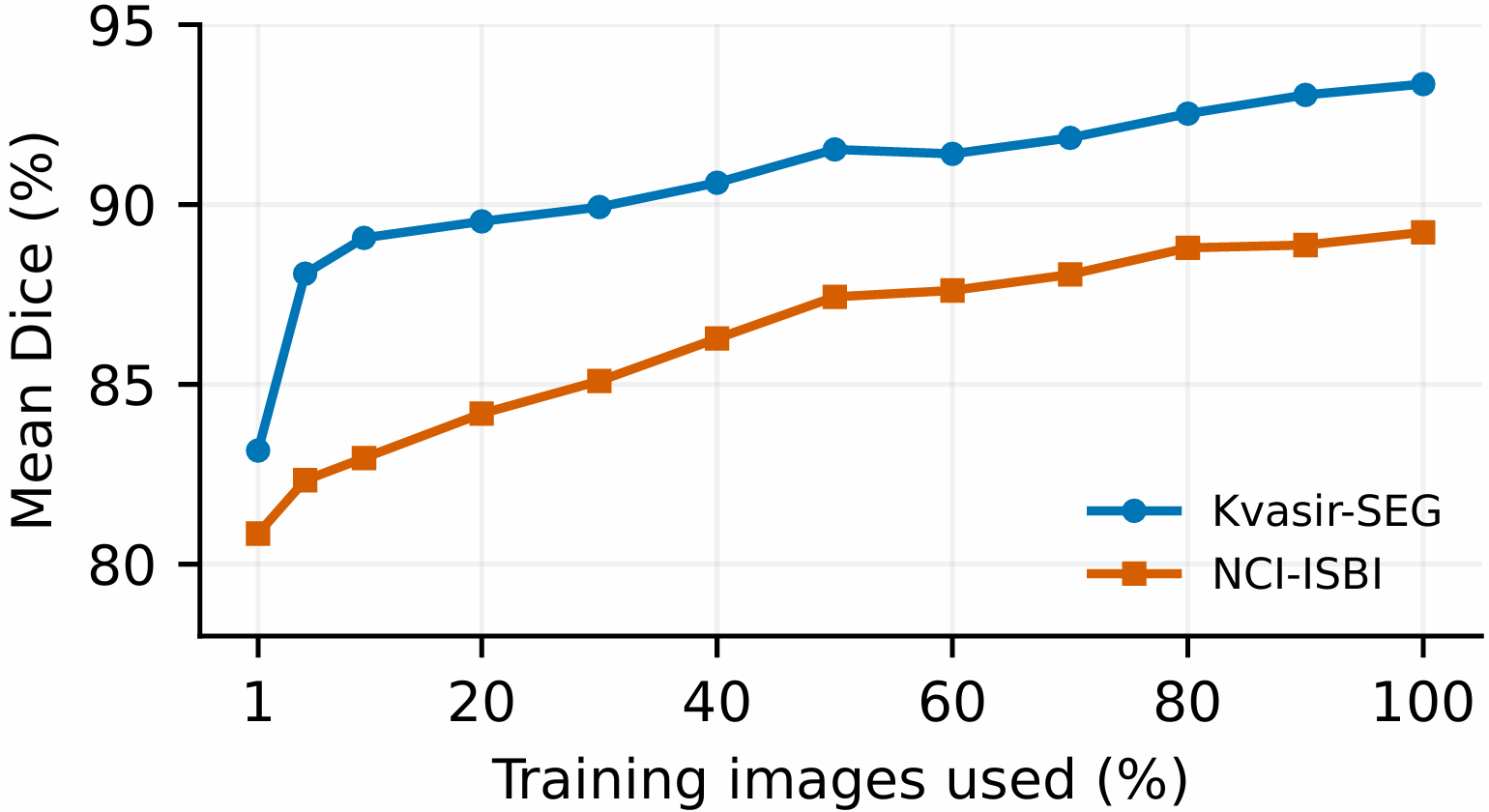
In the separate fixed-update experiment, nine Kvasir-SEG training masks yield 83.16% Dice and six NCI-ISBI training masks yield 80.85%. The six prostate slices span six patients. Fixed validation sets contain an additional 90 images and 73 slices, respectively.
Training-fraction experiment
QUALITATIVE COMPARISON
Target coverage and boundary alignment
One test case per dataset
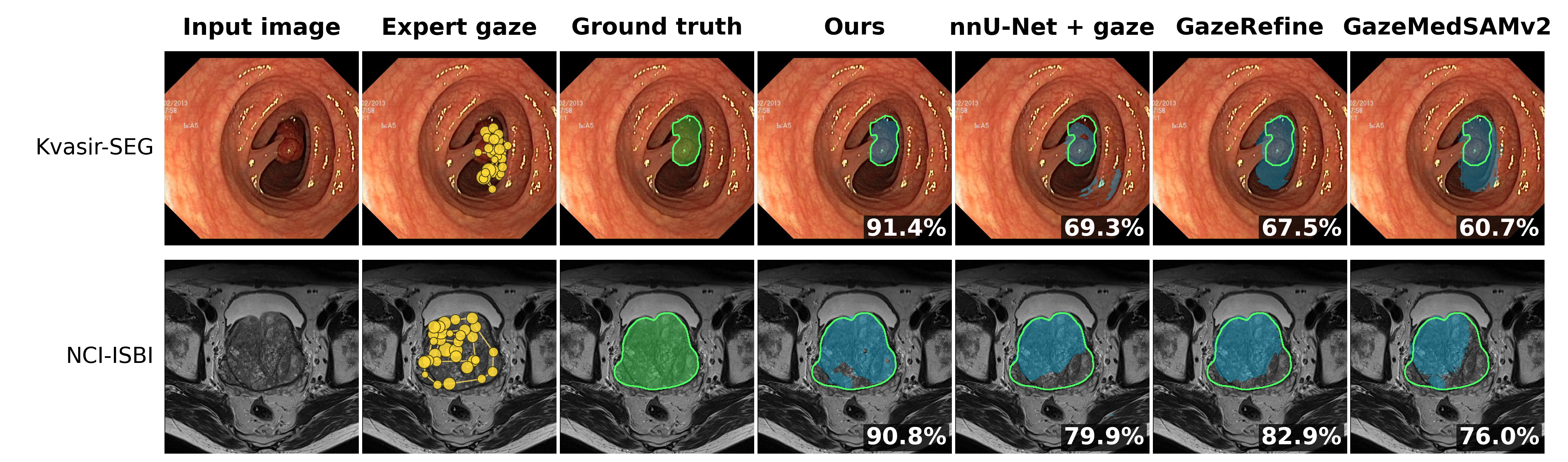
In the displayed polyp case, GazeLIFT follows the target contour while comparator predictions include additional regions. In the prostate case, GazeLIFT covers more of the annotated gland, while comparator predictions leave larger parts uncovered.
RESOURCES
Code and demo
Interactive segmentation
Run the trained model with an image and gaze fixations. The demo accepts fixation clicks and imported gaze records.
Open demo ↗Source
Model architecture, training and inference code.
Source code ↗Trained weights
Kvasir-SEG and NCI-ISBI trained adapters and their checkpoint hashes.
View model weights ↗